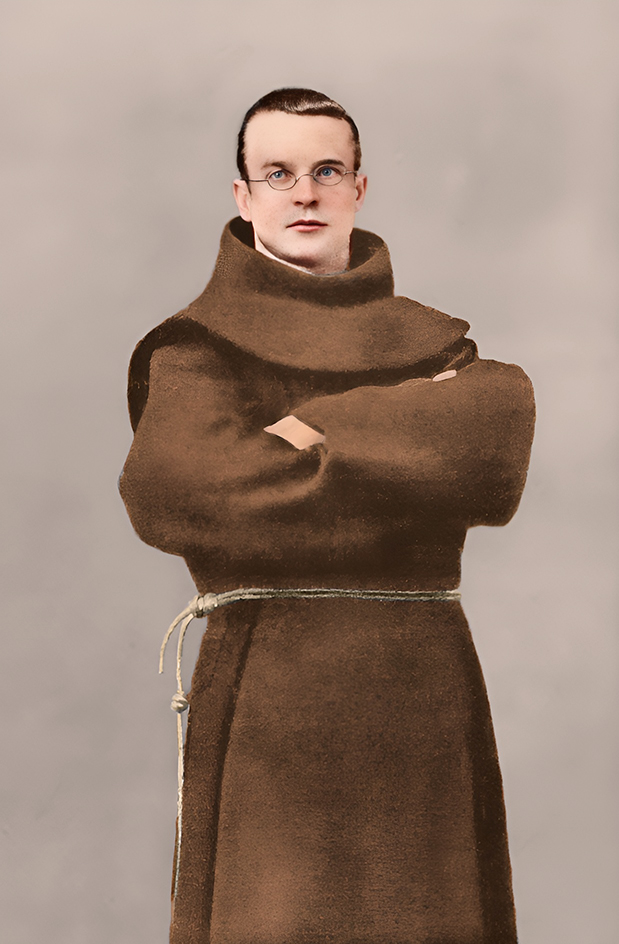
The Last Gasps of the Catholic Index of Forbidden Books

Joseph Martin McCabe (1867-1955). McCabe photographed in 1895, only months before he left the Church, was a prolific writer known for his trenchant and scholarly criticism of the Catholic Church and its official policies. Photo colorization © 2023 Roderick Bradford.

Read my latest article on the Index librorum prohibitorum in the May-August 2025 issue of The Truth Seeker here: https://publuu.com/flip-book/470081/1968145/page/24. The “flipbook” format replicates an actual codex magazine, but if you prefer a print copy you’ll have to subscribe ($35 per year for three issues).

I was previously unaware of this triannual magazine, which has been in existence since 1873 (!); it is billed as “The World’s Oldest Freethought Publication.” Its publisher, Roderick Bradford, reached out after reading my introductory blog post about the Index in the ALA/OIF “Intellectual Freedom Blog,” from 2018. With Bradford’s encouragement, I was able to expand on that piece, along with several other posts hosted here, to fashion a long-form article focusing on the last few decades of the Index‘s existence (c. 1920-1966).

This particular issue of The Truth Seeker also features various articles on the Scopes “Monkey” trial of July 1925, which brought the debate between faith/religion and science to national prominence in the United States. Lots to sink one’s teeth into, even one hundred years later.

I was also thrilled to share an issue (his article precedes mine) with S.T. Joshi, widely recognized as the foremost scholar of the life and works of American horror and science-fiction pioneer H.P. Lovecraft.

-RMS

The Top Ten Most Banned Books of 2023

Here are the top 10 most-challenged books in 2023, according to the American Library Association and as reported by the Wall Street Journal:

1. “Gender Queer: A Memoir,” by Maia Kobabe

2. “All Boys Aren’t Blue: A Memoir-Manifesto,” by George M. Johnson

3. “This Book is Gay,” by Juno Dawson 

4. “The Perks of Being a Wallflower,” by Stephen Chbosky 

5. “Flamer,” by Mike Curato

6. “The Bluest Eye,” by Toni Morrison 

7. (tie) “Tricks,” by Ellen Hopkins 

7. (tie) “Me and Earl and the Dying Girl,” by Jesse Andrews

9. “Let’s Talk About It: The Teen’s Guide to Sex, Relationships, and Being a Human,” by Erika Moen and Matthew Nolan 

10. “Sold,” by Patricia McCormick

The First Book on the Index?

Recently, via the American Library Association’s Intellectual Freedom Blog, I was asked the following:

Which was the first book ever to be condemned by the Church or to be entered in the Index?

This is an excellent question! It’s a little tricky to answer, however, for a few reasons. (SPOILER: There have been many Indexes!)

For one, the Church has banned books going back to its earliest foundations during the first centuries after Jesus Christ’s death (c. 30 AD). These banned books included texts considered apocryphal, or non-canonical, especially in regards to the New or Christian Testament, or otherwise sinful, scandalous, profane, etc. etc.. This was not done in a particularly systematic manner, however, as condemnations were fleeting and depended on the Church’s leadership at the given time.

Several semi-autonomous indexes existed in various parts of Europe. The first of them was published by the Faculty of Theology of the University of Paris (La Sorbonne), in 1544.

The Church did not have a fully consolidated Index until about 1564, upon the conclusion of the Council of Trent. If we take this date as our starting point, it becomes easier to isolate individual titles. Note that this date is not too long after Martin Luther initiated the Protestant Reformation in 1517. Essentially, any attempt at a definitive system of banning books or other texts is a response to the religio-cultural revolution that Luther set ablaze.

That said, according to de Bujanda et al. (Eds.), it is fairly easy to pinpoint those books entered into the Catholic Index of Forbidden Books around the year 1564 (day-specific dates of condemnation were not recorded — or at least are no longer extant — until 1571, when the Vatican’s Congregation of the Index was established).

A short selection of these books is as follows:

–A commentary on a work by the Roman historian Tacitus: ALTHAMER (BRENTZIUS), Andreas (c.1498-1560), Commentaria Germaniae in P. Cornelii Taciti Libellum de situ, moribus et populis Germanorum. Nuremberg: Johann Petreius, 1536;

–Four texts published in 1557 by Italian humanist and libertine Pietro ARETINO (1492-1556);

–A treatise on law by SCHURFF (SCHURPF), Hieronymus (1481-1554). Consiliorum, seu Responsorum iuris…, centuria prima. Frankfurt: Christian Egenolff, 1556.

Hope this answers it, at least somewhat!