The Last Gasps of the Catholic Index of Forbidden Books

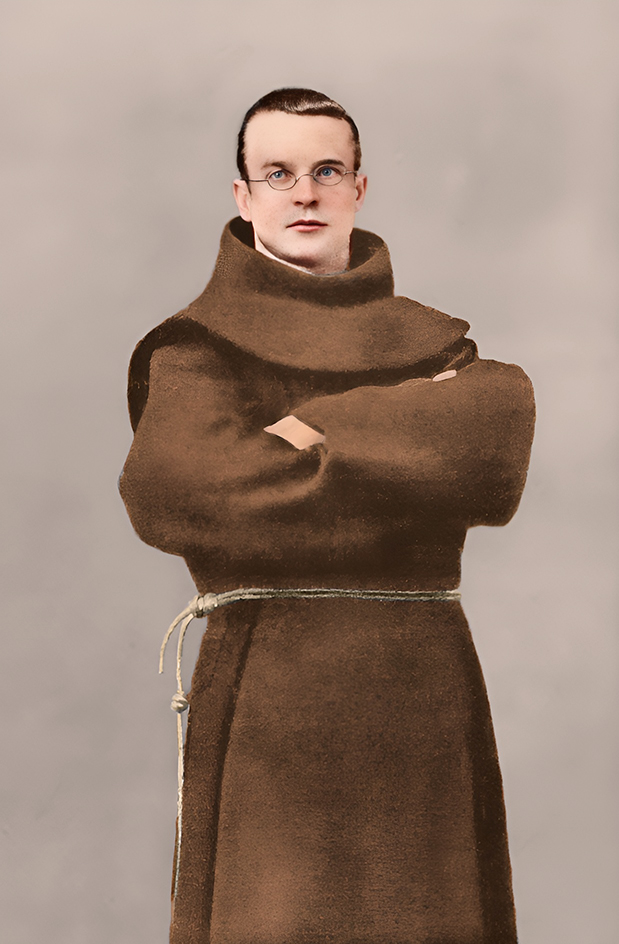
Joseph Martin McCabe (1867-1955). McCabe photographed in 1895, only months before he left the Church, was a prolific writer known for his trenchant and scholarly criticism of the Catholic Church and its official policies. Photo colorization © 2023 Roderick Bradford.

Read my latest article on the Index librorum prohibitorum in the May-August 2025 issue of The Truth Seeker here: https://publuu.com/flip-book/470081/1968145/page/24. The “flipbook” format replicates an actual codex magazine, but if you prefer a print copy you’ll have to subscribe ($35 per year for three issues).

I was previously unaware of this triannual magazine, which has been in existence since 1873 (!); it is billed as “The World’s Oldest Freethought Publication.” Its publisher, Roderick Bradford, reached out after reading my introductory blog post about the Index in the ALA/OIF “Intellectual Freedom Blog,” from 2018. With Bradford’s encouragement, I was able to expand on that piece, along with several other posts hosted here, to fashion a long-form article focusing on the last few decades of the Index‘s existence (c. 1920-1966).

This particular issue of The Truth Seeker also features various articles on the Scopes “Monkey” trial of July 1925, which brought the debate between faith/religion and science to national prominence in the United States. Lots to sink one’s teeth into, even one hundred years later.

I was also thrilled to share an issue (his article precedes mine) with S.T. Joshi, widely recognized as the foremost scholar of the life and works of American horror and science-fiction pioneer H.P. Lovecraft.

-RMS
The Top Ten Most Banned Books of 2023

Here are the top 10 most-challenged books in 2023, according to the American Library Association and as reported by the Wall Street Journal:

1. “Gender Queer: A Memoir,” by Maia Kobabe

2. “All Boys Aren’t Blue: A Memoir-Manifesto,” by George M. Johnson

3. “This Book is Gay,” by Juno Dawson 

4. “The Perks of Being a Wallflower,” by Stephen Chbosky 

5. “Flamer,” by Mike Curato

6. “The Bluest Eye,” by Toni Morrison 

7. (tie) “Tricks,” by Ellen Hopkins 

7. (tie) “Me and Earl and the Dying Girl,” by Jesse Andrews

9. “Let’s Talk About It: The Teen’s Guide to Sex, Relationships, and Being a Human,” by Erika Moen and Matthew Nolan 

10. “Sold,” by Patricia McCormick

Banned Books of the Mid-Twentieth Century

Recently, this question arrived in the BOTD inbox:

“Interested in looking through the Index listings for the 1930s, 1940s and 1950s. Can this be found online?”

The answer is YES. All of J.M. de Bujanda et al.’s Index des Livres Interdits may be found online via Google Books here.

I also went ahead and broke down my response by year to more specifically address the above question:

193019401950
193119411951
193219421952
193319431953
193419441954
193519451955
193619461956
193719471957
193819481958
193919491959

Of course, you can also insert any other years into the “Search in this book” bar. As in the canned searches above, just make sure to disregard from the results any entries that do not refer to condemnations but are rather an author’s birth or death year, for example.

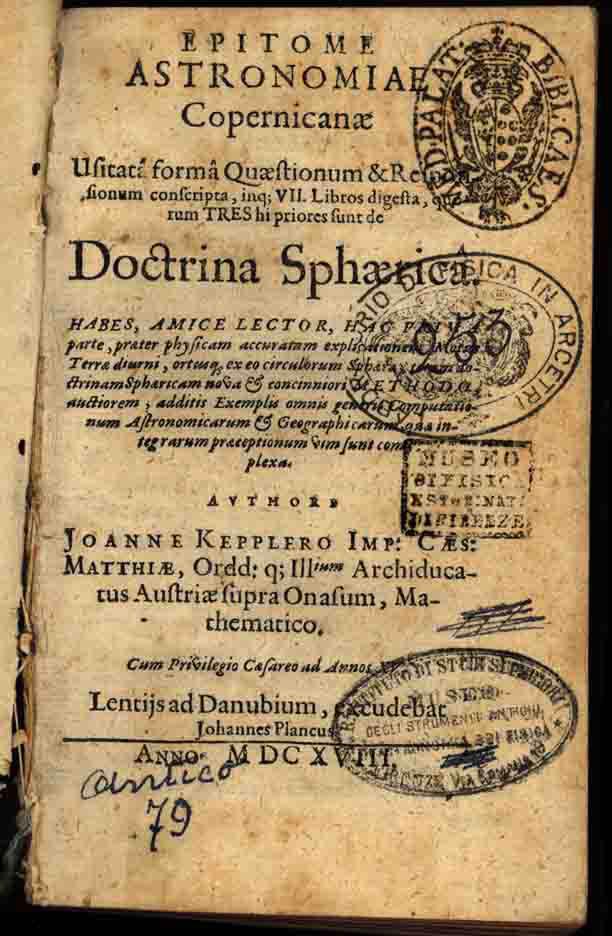
Epitome of Copernican Astronomy (1618-21)

Source: Digital Library, Museo Galileo

KEPLER, Johannes (1571-1630), Epitome of Copernican Astronomy & Harmonies of the World. Translated from the Latin to English by Charles Glenn Wallis. Amherst, NY: Prometheus Books, 1995.

Original citation: Epitome Astronomiae Copernicanae, usitata forma quaestionum et responsionum conscripta. Linz [Austria]: Johann Planck, 1618-21 [published in three parts].  

Condemned: May 10, 1619. 

Removed from Index: 1822.  

§2: Books including any heresy or schism attempting to destroy religious orthodoxy;

§7: Books engaged in any kind of superstition, fortune-telling, magic, spirit-conjuring, or other similar occult topics.

Read more

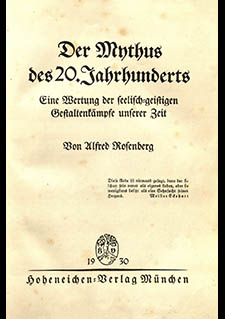
The Myth of the Twentieth Century (1930)

Note: After the attempted insurrection — a “putsch,” as one ABC News commentator called it — at the United States Capitol in Washington, D.C. two days ago, I felt it was necessary to post the following material. Originally I had planned to save this section for the manuscript I have very slowly been working on over the last several years. But since I am already engrossed in a different manuscript project — one that actually has a publishing contract and, thus, a hard deadline — due to its timeliness I felt compelled to post it here instead.

Adolf Hitler and his Nazi associates, including this article’s subject, Alfred Rosenberg, perpetrated in Munich in November of 1923 an armed, attempted coup. Later, this event would become known as the “Beer Hall Putsch.” Before it could be put down, 16 Nazi Party members and four police officers had died. Though it failed, many historians point to it as the start of the rise of the Nazis’ genocidal, fascist regime.

Source: Widerstand!? [“Resistance!?”]

ROSENBERG, Alfred (1893-1946), The Myth of the Twentieth Century: An Evaluation of the Spiritual-intellectual Confrontations of Our Age. Translated from the German to English by Vivian Bird (1st English ed.). Torrance, CA: Noontide Press, 1982.   

Original citation: Der Mythus des 20. Jahrhunderts: Eine Wertung der seelisch-geistigen Gestaltenkâmpfe unserer Zeit. München (Munich): Hoheneichen-Verlag, 1930. 

Condemned: February 7, 1934. 

Additional notes/condemnations: Also see STROOTHENKE, Wolfgang (1913-1945), Erbpflege und Christentum; Fragen der Sterilisation, Aufnordung, Euthanasie, Ehe. Mit einem Geleitwort von Fritz Lenz. Leipzig: L. Klotz, 1940. Condemned: February 19, 1941. 

§2: Books including any heresy or schism attempting to destroy religious orthodoxy;

§3: Books that attempt to attack religion or good morals;

§4: Books by non-Catholics dealing in any way with religion (unless in total agreement with Catholic dogma);

§5: Books and booklets including mention of any new appearances [of saints or other divine spirits], revelations, visions, prophecies, and miracles, even under the pretext of private publication;

§6: Books that scorn or ridicule the Church or Catholic dogma in any way;

§7: Books engaged in any kind of superstition, fortune-telling, magic, spirit-conjuring, or other similar occult topics.

Read more

The First Book on the Index?

Recently, via the American Library Association’s Intellectual Freedom Blog, I was asked the following:

Which was the first book ever to be condemned by the Church or to be entered in the Index?

This is an excellent question! It’s a little tricky to answer, however, for a few reasons. (SPOILER: There have been many Indexes!)

For one, the Church has banned books going back to its earliest foundations during the first centuries after Jesus Christ’s death (c. 30 AD). These banned books included texts considered apocryphal, or non-canonical, especially in regards to the New or Christian Testament, or otherwise sinful, scandalous, profane, etc. etc.. This was not done in a particularly systematic manner, however, as condemnations were fleeting and depended on the Church’s leadership at the given time.

Several semi-autonomous indexes existed in various parts of Europe. The first of them was published by the Faculty of Theology of the University of Paris (La Sorbonne), in 1544.

The Church did not have a fully consolidated Index until about 1564, upon the conclusion of the Council of Trent. If we take this date as our starting point, it becomes easier to isolate individual titles. Note that this date is not too long after Martin Luther initiated the Protestant Reformation in 1517. Essentially, any attempt at a definitive system of banning books or other texts is a response to the religio-cultural revolution that Luther set ablaze.

That said, according to de Bujanda et al. (Eds.), it is fairly easy to pinpoint those books entered into the Catholic Index of Forbidden Books around the year 1564 (day-specific dates of condemnation were not recorded — or at least are no longer extant — until 1571, when the Vatican’s Congregation of the Index was established).

A short selection of these books is as follows:

–A commentary on a work by the Roman historian Tacitus: ALTHAMER (BRENTZIUS), Andreas (c.1498-1560), Commentaria Germaniae in P. Cornelii Taciti Libellum de situ, moribus et populis Germanorum. Nuremberg: Johann Petreius, 1536;

–Four texts published in 1557 by Italian humanist and libertine Pietro ARETINO (1492-1556);

–A treatise on law by SCHURFF (SCHURPF), Hieronymus (1481-1554). Consiliorum, seu Responsorum iuris…, centuria prima. Frankfurt: Christian Egenolff, 1556.

Hope this answers it, at least somewhat!

An Update

Apologies for not posting more lately!

I am happy to report, however, that during the last three months’ hiatus I’ve been busy working on the longer-term version (and vision) of this project. I’ve been developing the draft manuscript that will, with luck, someday become a full-length book. This work has been concentrated mostly within my week-long research visits to the Houghton Library and the Harvard University Library system in general since July of last year. With those resources and the (so far) three weeks of dedicated time for reading, outlining, and writing, I feel confident that I am now well on my way.

If you’ve missed my posts on the American Library Association’s Intellectual Freedom Blog related to the first two of these trips, see July’s here and October’s here. The post for my most recent trip, January 20-27, 2019, will be posted shortly at the same location (see my Instagram account linked above for a few photos and notes). My final week at Harvard will most likely take place this upcoming May or June.

As a bit of a preview, below is an outline of the annotated bibliography section of my current draft outline — the “Bibliography of the Damned” itself. These 46 author entries correspond with four chronological categories…with a twist for the fifth that you’ll have to wait for the book to find out the meaning of. Mystery!

Also: This outline is subject to change.

Part III: A Bibliography of the Damned

  1. Circa 1600 to 1700
    • BRUNO, Giordano
    • COPERNICUS, Nicolaus (Micołaj Kopernik)
    • DELLON, Charles
    • DESCARTES, René
    • GALILEO Galilei
    • HOBBES, Thomas
    • KEPLER, Johannes
    • SPINOZA, Baruch (Benedictus de)
    • PERKINS, William
    • WILKINS, John
  2. 1700 to 1800
    • DARWIN, Erasmus
    • DIDEROT, Denis
    • ENGEL, Samuel
    • GIBBON, Edward
    • KANT, Emmanuel
    • MANDEVILLE, Bernard
    • MIDDLETON, Conyers
    • “PARKER” [Anonymous]
    • ROUSSEAU, Jean-Jacques
    • VOLTAIRE (François-Marie Arouet)
  3. 1800 to 1900
    • CASANOVA (Giacomo Girolamo Casanova de Seignault)
    • CIOCCI, Raffaele
    • FLAUBERT, Gustave
    • HUGO, Victor
    • MORGAN, Lady Sydney Owenson
    • RICHMOND, Legh
    • SAND, George (Amandine Lucile Aurore Dupin)
    • STENDHAL (Marie-Henri Beyle)
    • VÉRICOUR, Louis
    • WHATELY, Richard
  4. 1900 to 1966
    • BEAUVOIR, Simone de
    • DELLHORA, Guillermo
    • HOUTIN, Albert
    • KAZANTZAKIS, Nikos
    • ROSENBERG, Alfred
    • SARTRE, Jean-Paul
    • STEINMANN, Jean
    • STROOTHENKE, Wolfgang
    • SULLIVAN, William Lawrence
    • UNAMUNO, Miguel de
  5. Works out of Time
    • DANTE Alighieri
    • JULIANUS AUGUSTUS, Flavius Claudius (Julian the Apostate)
    • LUCRETIUS (Titus Lucretius Carus)
    • LUTHER, Martin
    • MERLIN (the Wizard)
    • TACITUS, Publius Cornelius